So, when are you going to retire?
After fifty years in the Piano Girl business—a lifetime of performing in hotels, bars, roadside dives, European grand hotels, and castles—part of me wants to exit stage left and fade into cocktail lounge obscurity. Maybe I could recline on a brocade sofa while a younger, perkier pianist serenades me with music that I might or might not need to hear, while one of my long-suffering family members serves me basil-infused mocktails and platters of puffy vegan snacks. How grateful I would be.
But then what? Would I myself grow puffy? Might I morph into one of those aging musicians with a smooth forehead and worn-out stories that listeners pretend to hear for the first time? Would I wear a feathered caftan and sink into a pit of melodramatic woe accompanied by dirges in D minor; or worse yet, pretend that I don’t miss my colorful happy-happy-happy hour applause-filled flower-strewn life at all?
Maybe. Melodrama has its charms. But I fear I would become insufferable with my need to replay my Piano Girl memories—they are both a silly and substantial part of my life story.
Here’s one tale I would tell too many times: I played my very first gig in 1976, the bicentennial summer, at the Club Car bar and restaurant on Nantucket Island. I was eighteen and clueless but so stuffed with joy that I didn’t know enough to be wary. My sunswept audience—drunk on Singapore slings and guileless patriotism—tilted into the holiday with squinty, sunbaked eyes. Privilege intact, they ate seared-scallop appetizers and lobster tails and licked drawn butter from their salt-crusted fingers. I sat at the piano and pounded out every patriotic song ever written. Anchors away! They waved their grande olde flags and did their best Kate Smith impersonations. They God-blessed America and God-blessed themselves, to the shores of Tripoli, and beyond.
At the end of my third set, I bustled outside with a gaggle of boozy patrons in Nantucket-red pants. We trundled down Main Street’s thick cobblestones to the wharf and watched fireworks fill the smoldering horizon. The fireworks were gentle by today’s standards, but at the time they seemed like giant, explosive predictors of an unflappable future.
But that’s just one fifty-year-old music-inspired story, and I have a million more. See? I’m already making an ass-shaped dent in my brocade sofa.
Fun fact: The very first song I played on my very first gig at the Club Car was Carole King’s “So Far Away.” I occasionally still play it, and whoosh—I’m carried back to the summer of ‘76. I can almost smell the bluefish-y sea and taste the stale bar snacks and recall the glory of my eighteen-year-old tube-topped self. So much ahead of me, so much to gain, loping into my future without filters, boundaries, or any awareness at all. The memories of that time are still there, wrapped inside a song.
Now, at age sixty-eight, I can’t avoid thinking about loss. My parents are nonagenarians and coping with the delights and miseries of old age. They have earned the right to be old and tired. Having launched three kids into reasonable adulthoods, they’re now occupied with their own survival. My father, who reluctantly retired from the music business at the age of ninety, still has a natural knack for storytelling. The propensity for gig-inspired humor seems to run in the family. I get it—his stories help keep him alive. Almost all of them are connected to music.
It’s hard to imagine that fifty-years ago they drove me from Pittsburgh to Nantucket Island, a cradle to cocktail-lounge journey that jump-started a career that has outlasted everyone’s meager predictions for me. A girl with too many bikinis, a few black turtlenecks, and a working knowledge of the works of Carole King does not exactly call forth images of artistic genius.
“Let’s get this show on the road,” my mother used to say to me back then. She was anxious to get me out of the house, out on my own, and regain a portion of her own life.
“Don’t forget the duct tape and the extension cord,” my dad said when I landed that first Nantucket piano job, sounding like I was entering a kidnapping ring instead of the nightclub business. “And don’t drink on the job.” Did I listen? No. But the sentiment stays with me, especially when I play a song I learned during the summer of ‘76. I can still envision my parents, borderline empty-nesters, perched on the top deck of a Steamship Authority ferry, surrounded by baggage. So far away is right.
The boys, the men, the mashers, the swains—some of them are linked to songs I still play whenever I want to remember my dodgy serial-dating history. Ah, the guys I encountered while playing in eighties New York City, Nantucket, Pittsburgh, and Haiti, of all places. I somehow survived and thrived and kept working.
I settled down and met John, my husband of thirty-eight years, when we were both playing at the Grand Hyatt in Manhattan. He performed with a jazz trio in the granite lobby, while I provided ambient cocktail piano music in a pleather and velvet-lined womb called Trumpet’s. Yes, the hotel was partially owned by that Donald, who had named the lounge after himself. John and I fell in love between sets of swinging standards (John) and obscure originals (me). Our music was ignored by most of the commuters cavorting through the lobby, but we didn’t care. We had the world on a string, entertaining our dreams of New York City grandeur under very full heads of ‘80s hair.
“Welcome to the Hyatt,” John said to me. “Catch the wave.” It was a big wave. It has carried us far.
I worry that I will outlive John, even though he’s the strongest human being I know. He’s also my musical advisor and occasional chord doctor. Every bit of sophistication that emanates from my fingers comes from John, even though he always tells me I sound good. If he’s not around, who will encourage me to sound less like a musical version of a graham cracker? And who will listen to my stories? No sir, I cannot play the Rachmaninoff Piano Concerto Nr. 3, even if you do give me five bucks and a Moscow Mule. Who will remind me that love is the only thing that matters? He does, all the time. But music can do that too. Not always, but sometimes.
Our two children, young adults with their best years still to come, are shifting into high gear without me, as they should. Our kids grew up watching John play at the Cologne Philharmonic Hall and hanging out with me at the German castle where I performed for fourteen years. It seems impossible that the children I guarded like a Steinway-playing lioness are now out on the continental tundra, running free and fending off the hyenas, taking on the world, building their own families.
Because I’ve continued to show up, a few good things have happened over the years. The good things are framed by lots of bad things, or funny things, or depressing things, and I’ve written about many of them. All of this comes from playing hundreds of live performances every year while cake-walking the perceived line between dedication to art and dedication to family. I realize now there’s no actual line—the connection between family memories and music has always been deep and meaningful.
I have too many stories, but my ass is falling asleep on this damn sofa.
One more thing: The friendships I have cherished over the past fifty years, are, with a few exceptions, faded scraps of what was once vibrant, whole cloth. Colleagues, cast members, gal-pals, my gay guys—where are the friends who lifted me off the metaphorical sticky floors of New York nightclubs when I was dopey or sad? The friends who traded dreams and sipped random vodka concoctions with me when everyday life cluttered our inability to see more than five minutes into the future?
Where are they? Lodged in the core of my aging, aching heart. I play and memories of them return. I’m thinking right now about eighties Manhattan and Michael. He was a cocktail server and fellow musician who saved my sanity, and possibly my life, after I was threatened—at a 7th Avenue hotel piano—by a mentally ill man who wielded a cloth-less umbrella as a weapon. Death by spokes, Michael said.
People leave, they die, they walk or run or crawl away, they fade into the past or fizzle into the future like fireworks in a bicentennial sky. But a song? There’s something about playing a song that helps me remember my people, my orchestra invisible, my choir of long-gone cheerleaders. I guess that’s the point.
Music is not my life—I am more than a jumbled mess of rhythm, melody, and harmony. I play the piano to make a living—it’s my number one source of income and has adequately financed my middle-class artistic life. But I have also played for validation, solace, structure, and, most importantly, connection. In an increasingly disconnected world, bonding with a listening audience feels like stumbling into a hidden community of old-school civility. Take that, AI.
Sometimes, I don’t feel like playing at all, but those times are rare. To combat my aching back, the doldrums, or basic menopausal fatigue, I play songs that remind me of the dearest people I have known—my parents, my children, my sister, my brother, my grandparents, my aunts and uncles, my friends, my husband. Then I feel better.
So no, I won’t retire anytime soon, because I need to remember what I know. I need to hold on to all of you. Fifty years is a long time in any business, but in the music world, it goes by one note at a time, like evanescent, sun-swept swathes of gold upon canvases of blue sky—tiny aural glimmers that light my memory and then diminish into trails of whispered love. Not retiring—not just yet.
Listen to me ramble. Or better yet, listen to me, or any other career musician, play. We have stories that sing.
I am one very lucky, a little bit puffy Piano Girl.
Robin Meloy Goldsby has been performing at Excelsior Hotel Ernst for the past eleven years. She is a popular solo piano artist with over 250 million streams on Pandora in the USA. Listen to her music on all streaming platforms.
Goldsby’s newest book, Piano Girl Playbook: Notes on a Musical Life [Backbeat Books/Bloomsbury], is available in hardcover and ebook editions from bookstores everywhere. She is also the author of Piano Girl: A Memoir; Rhythm: A Novel; Waltz of the Asparagus People: The Further Adventures of Piano Girl; and Manhattan Road Trip: Short Stories.
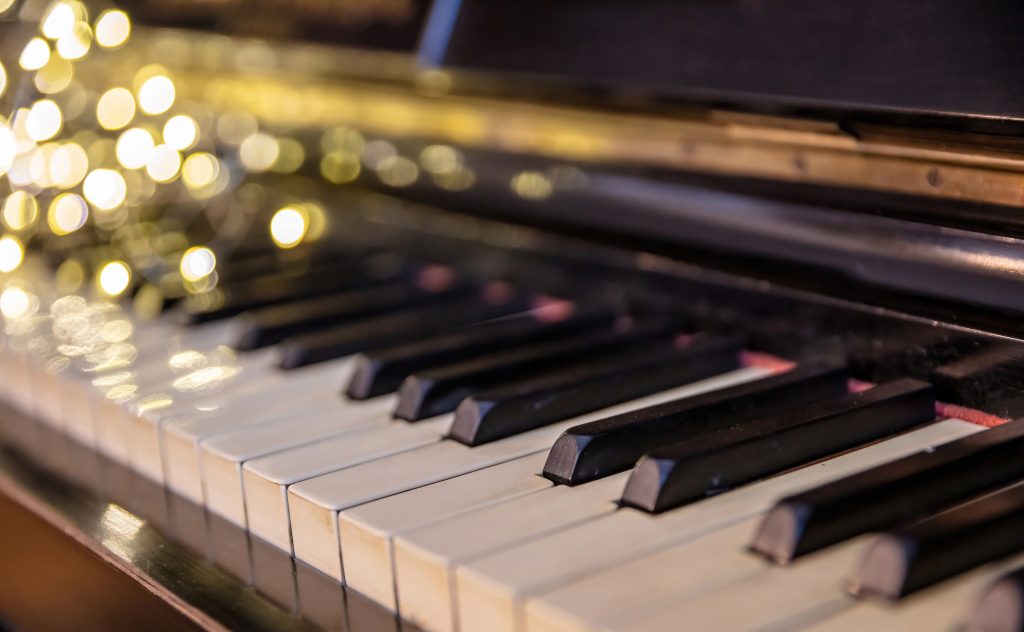
Antique piano photo courtesy of Envato. Piano Girl Playbook cover art by Julia Meloy Goldsby.
